Flour
Teff flour: the gluten-free grain behind injera, rich in iron
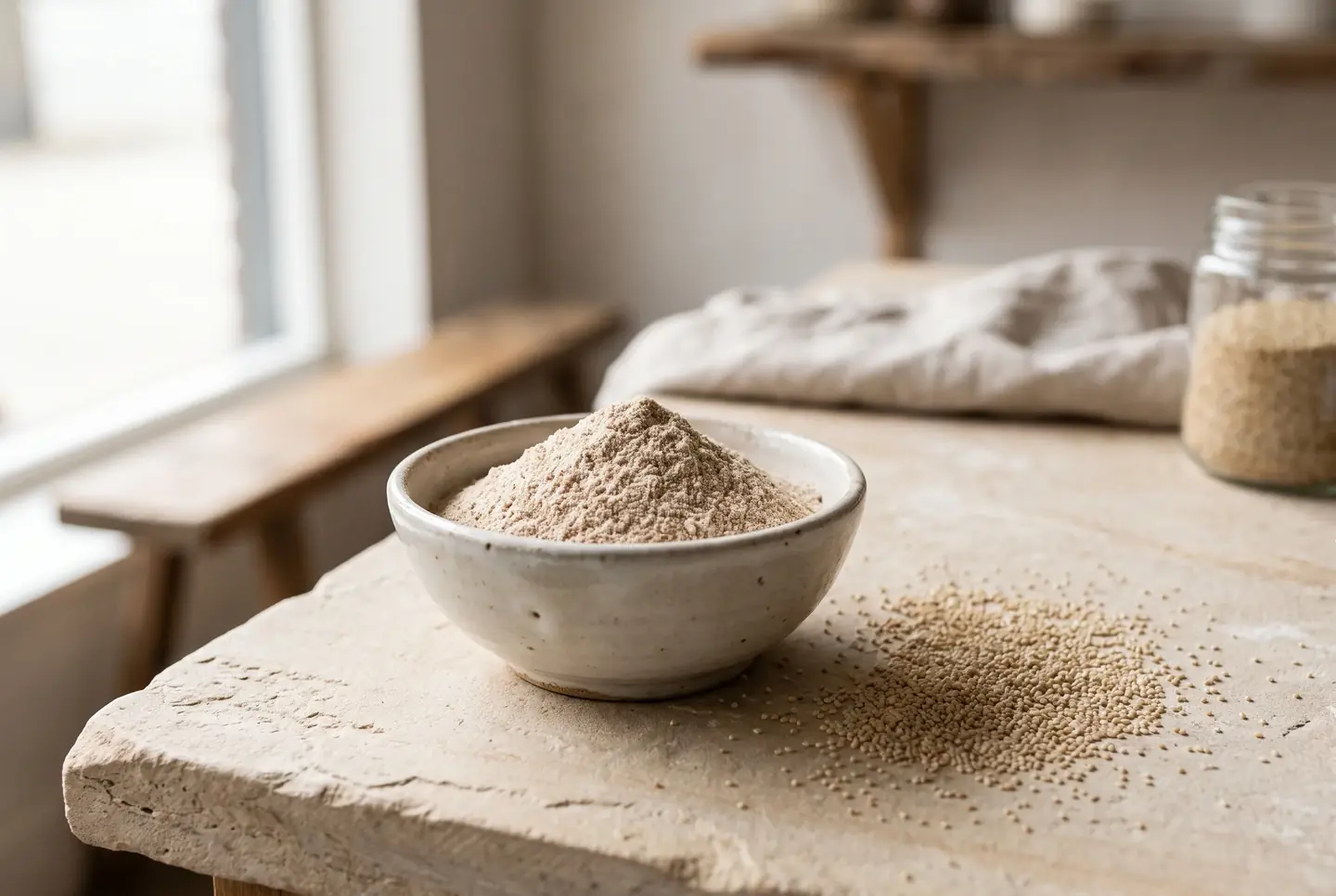
Teff flour is milled from the smallest grain in the world, Eragrostis tef, and it always reaches the kitchen wholegrain, because the seed is too tiny to sift bran and germ apart. It is naturally gluten-free, ranges from ivory to deep brown, and it is the flour that gives Ethiopian injera its tang and its spongy, eyed surface.
At a glance
- Strength (W)
- not measured
- Protein
- 12.2% to 13.3%
- Water absorption
- not measured
- Stability
- not measured
- Ash
- 2% to 3.2%
- Origin
- Etiópia e Eritreia (planalto do Chifre da África)
- Grain
- Eragrostis tef, o menor grão cereal cultivado do mundo, sempre integral e sem glúten
What it is called in each country
| Country | Called |
|---|---|
| English | Teff flour; ivory (white) or brown (red) teff; US/UK health-food shops and Ethiopian grocers. |
| Português | Farinha de teff; grão etíope, sempre integral, sem glúten (nicho, loja de produtos naturais). |
| Italiano | Farina di teff; cereale etiope, sempre integrale, senza glutine. |
| Français | Farine de teff; céréale éthiopienne, toujours complète, sans gluten. |
| Español | Harina de teff; grano etíope, siempre integral, sin gluten (España y Latinoamérica). |
What it is for
Teff flour is for fermented flatbread, porridges, pancakes, rustic cookies and earthy cakes. The anchor use is injera, the thin, spongy sourdough flatbread of Ethiopia and Eritrea, made from nothing but teff and water and fermented for days until it turns sour and covered in tiny holes. Because it is wholegrain and gluten-free, it delivers fibre, iron and a flavour that leans toward hazelnut and molasses, stronger in brown teff and gentler in ivory. In gluten-free baking it works as a character flour: it brings colour, aroma and moisture to blends that would otherwise taste flat. It earns its place as part of an everyday gluten-free bread mix.
How to substitute it
In ordinary wheat breads and cakes, swap 20 to 30 percent of the white flour for teff to gain colour, fibre and flavour without wrecking the structure. What changes: the crumb turns darker, moister and denser, with notes of cocoa and nuts. Go higher and the available gluten drops, so the crumb starts to crumble, because teff builds no elastic network. In recipes that are already gluten-free, teff replaces part of the buckwheat or sorghum well, deepening colour and adding sweetness. There is no one-to-one swap in long-fermented breads that rely on strength: here teff is a partner, not the structural base.
When not to use it
Teff gets in the way when you want a tall, open crumb white loaf: with no gluten, it holds no gas and will not rise like wheat. It is also the wrong choice when you need a pale colour and a neutral taste, such as a light sandwich loaf or a delicate sponge, because it tints and perfumes everything. In large amounts in a wheat recipe, it leaves the result heavy and brittle. And it is not a fine sauce thickener, where its earthy flavour comes through too much.
How to use it
Teff drinks a lot of water: because it is wholegrain and high in fibre, hydrate the dough well and let it rest for 20 to 30 minutes so the bran swells and the crumb does not bake out dry. In gluten-free baking, pair teff with a binder such as psyllium, xanthan gum or egg to give the cohesion that gluten would provide. Injera runs on a different logic: a touch more water, one to three days of fermentation and a very hot griddle to open the eyes on the surface. Start with a small proportion of teff in a blend and build up slowly, tasting colour and flavour at each step.
How to choose one when buying
On the label, look for wholegrain teff flour and check the colour: ivory (or white) is milder and sweeter, a good place to start; brown (or red) is deeper, earthy, almost molasses-like. Health-food shops, Ethiopian grocers and specialty importers carry the Ethiopian grain; in the US and UK, Bob's Red Mill is the easiest brand to find. Check the certified gluten-free seal if you have coeliac disease, since cross-contamination at the mill is possible. Store it in an airtight jar away from heat and light: like any wholegrain flour, teff carries oil in the germ and can go rancid. In a warm climate, the fridge extends its life.
The story
Teff has been domesticated for thousands of years on the highlands of present-day Ethiopia and Eritrea, in the Horn of Africa, where it is a staple food and a mark of cultural identity. Its name points to the tiny size of the grain, so small it is easily lost, and it is exactly that smallness that keeps the flour wholegrain. From harvest to table, its finest destiny is injera: a batter of teff and water fermented by microbes that live on the surface of the grain, baked into a wide disc and used as plate, bread and utensil at once. Beyond Africa, teff has grown as a gluten-free grain in health-food shops and in kitchens chasing iron and fibre, and it now turns up in breads, pancakes and cakes around the world.
Frequently asked
- Is teff flour gluten-free?
- Yes. Teff is naturally gluten-free, which makes it suitable for people with coeliac disease, as long as the pack carries a certified gluten-free seal to rule out cross-contamination at the mill.
- What is the difference between ivory and brown teff?
- It is colour and flavour. Ivory (white) is milder and slightly sweet; brown (red) is deeper and earthy, with molasses notes. Both are wholegrain and nutritious, so the choice comes down to taste.
- Can I make bread with teff flour alone?
- For injera, yes: that is the traditional recipe, just teff and water fermented. For a tall, soft sandwich loaf, not on its own: with no gluten, teff needs a binder (psyllium, gum or egg) and usually joins a blend of other flours.
- Is teff flour a good source of iron?
- Yes. According to the USDA, teff carries roughly 7 mg of iron per 100 g, high for a cereal, along with fibre and calcium because it is wholegrain. Some of that iron depends on the variety and the soil.