Flour
Chickpea flour: what it is, what it is for, and why it does not make wheat bread
It builds no gluten. No W strength, no network, and that is what decides what it is for and what it is not. This is not a bread flour that failed to rise: it is ground chickpea, a different thing, and the table below shows where it shines.
At a glance
- Strength (W)
- not measured
- Protein
- 15% to 22% *
- Water absorption
- not measured
- Stability
- not measured
- Ash
- not measured
- Origin
- Índia (besan, do chana dal) e bacia do Mediterrâneo (farinata, socca)
- Grain
- leguminosa (Cicer arietinum), sem glúten
Sources disagree. Datasheets disagree because the number depends on the grain and the milling. Indian besan, from chana dal, tends to declare close to 22% protein; flour from whole white chickpeas sits a little lower, and retail labels turn up quoting 15%. The USDA entry for besan gives 22.4% protein and 6.7% fat per 100 grams. Buy on the nutrition panel, not on the number on the front of the pack.
What it is called in each country
| Country | Called |
|---|---|
| English | chickpea flour / gram flour / besan / garbanzo bean flour (besan = do chana dal, mais fina; garbanzo = do grão inteiro) |
| Português | farinha de grão-de-bico (low carb e sem glúten; às vezes vendida como inativada ou tostada) |
| Italiano | farina di ceci (farinata ligure, cecina toscana, panelle siciliane) |
| Français | farine de pois chiche (socca à Nice, panisse à Marseille, cade à Toulon) |
| Español | harina de garbanzo (panelle, tortillitas de camarones, falafel) |
What it is for
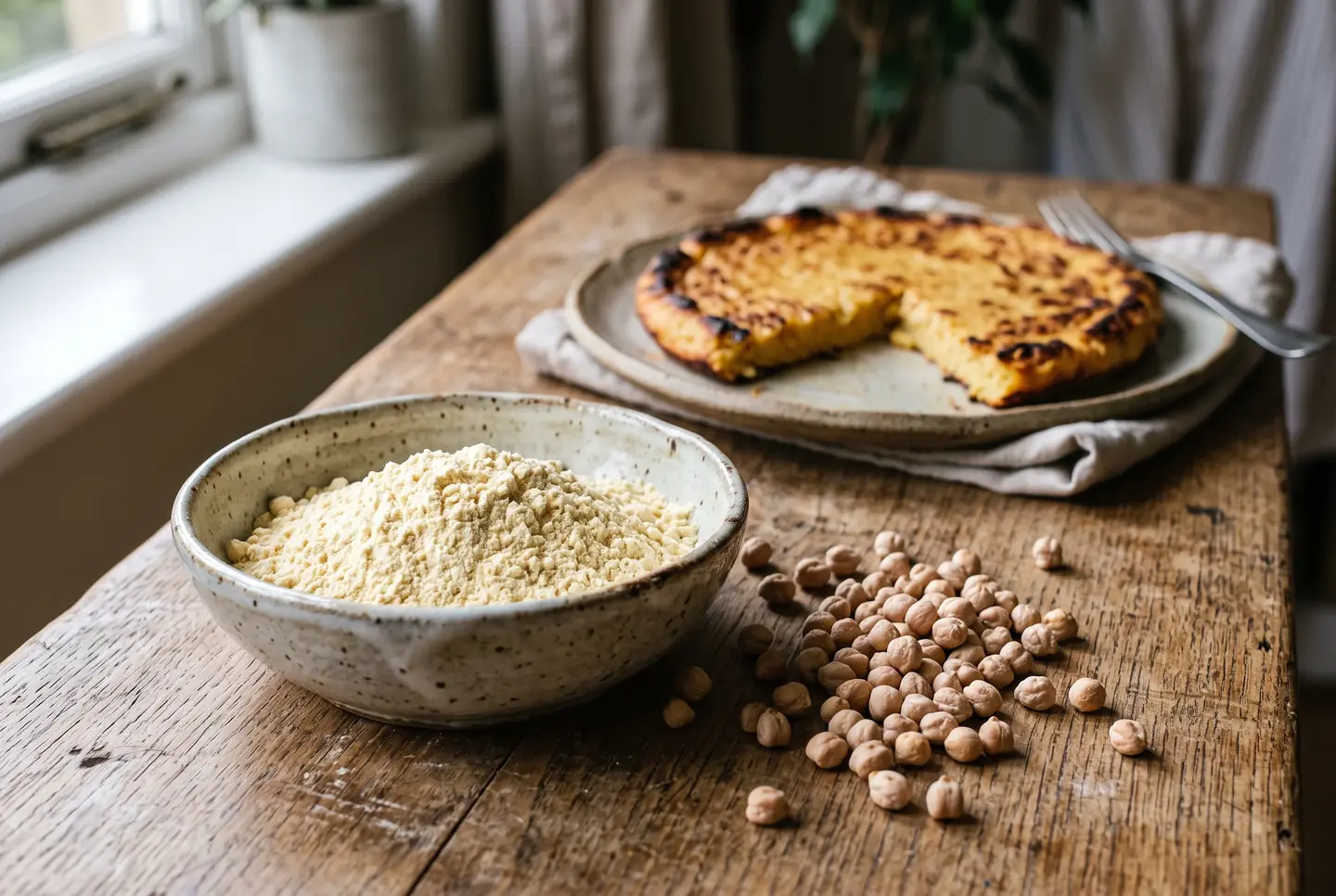
Its home ground is savoury, not risen bread. Farinata and socca, the thin disc of chickpea, water, olive oil and salt baked in a blazing oven. Panelle and panisse, where the same batter is cooked to a thick paste, cooled, cut and fried. The tortillitas de camarones of Cadiz, fried in lacy shreds. And the whole Indian line: pakora and bhaji batter for coating and frying vegetables, chila as a savoury pancake, besan to thicken curry and bind kofta.
In risen wheat bread it plays a supporting role only, in a small blend of about 15% to 20% of the total flour, to add protein, colour and a nutty background. In rustic flatbreads, in the pita family, that pinch sits well. What it does not do is act as the main flour of a loaf that has to rise high.
How to substitute it
Two swaps make sense, and one does not.
As an egg replacer in savoury cooking it is excellent: 3 tablespoons of chickpea flour with 3 tablespoons of water make a paste that binds like an egg. The protein sets in the heat and holds the structure, the trick behind many a vegan omelette, veggie burger and eggless coating. Hydrate the flour with the water before adding it to the rest, or you keep a raw taste.
As the body of a pancake or fritter batter, it swaps for wheat by drinking more water and binding on its own, no egg needed. What changes is texture: denser, moister, with a legume flavour wheat does not have.
What does not work is trading wheat for chickpea gram for gram in a loaf that leans on gluten. With no network there is nothing to hold the gas, and it collapses. For a touch, stay at the 15% to 20% already noted and accept a stickier dough and a tighter crumb. Above that, you are no longer reinforcing a wheat loaf, you are making something else.
When not to use it
Airy wheat bread, the tall open-crumbed kind that relies on a gluten network to inflate: baguette, ciabatta, soft sandwich loaf, brioche. With no gluten the physics that traps air is simply absent, and chickpea flour on its own gives a dense brick, not a loaf.
Delicate pale cake, no either: the legume flavour takes over and the structure comes out heavy. And raw, it is bitter, leaving a green-bean taste that many people mistake for spoiled flour.
How to use it
It drinks a lot of water and improves with a rest. Classic socca batter is made the day before: hydrate the flour and let it soak for a few hours, sometimes overnight, which takes the bitterness off, hydrates it evenly and leaves the batter lighter. The same patience pays in any chickpea batter.
The raw bitterness cooks off. If your dish does not go through a hot enough oven or pan, toast the dry flour in a dry pan for a few minutes before using it, or buy a pre-treated grade. It is common to find chickpea flour sold as toasted or heat-treated precisely for this.
Sift to break up the lumps, because it clumps easily in water, and weigh rather than scoop by cup: ground legume packs down in a way the cup cannot control, and in a batter that decides between thin and rubbery.
How to choose one when buying
The first choice is besan versus whole-chickpea flour. Besan, from Indian grocers, is milled from chana dal: finer, yellower, earthier, and it needs less water. Flour from whole white chickpeas is paler, coarser and drinks more. For farinata and panelle either one works; for Indian cooking, besan is the original.
Prefer the stone-ground, fine grade, which hydrates evenly. Check freshness and smell: the flour carries some fat, so it goes rancid over time, and an old bag smells musty. Keep it in a sealed jar somewhere cool, and in the fridge if you use it slowly.
Every market names it differently: besan or gram flour in India and Britain, garbanzo bean flour in the United States, farina di ceci in Italy, farine de pois chiche in France, harina de garbanzo in Spain. Do not trust the protein figure on the front: it shifts with the type of grain and with how much fat has been removed.
The story
The chickpea is a legume, Cicer arietinum, a cousin of the bean and the lentil, not a cereal. Grinding it into flour is an old habit in two worlds that barely speak to each other.
On one side, the Mediterranean. In Nice it is socca, in Liguria farinata, in Tuscany cecina, in Sicily panelle, in Marseille panisse, in Toulon cade. Street food with centuries behind it: the Genoese legend says it began with a shipwreck, sacks of chickpea and seawater drying in the sun on deck. True or not, the dish was born in port cities, where cheap pulses and a hot oven always met.
On the other side, India, where the flour is besan, one of the subcontinent's most-used ingredients. And here is the distinction that trips up half the internet: traditional besan is not milled from the big pale chickpea most of us know (the kabuli type), but from chana dal, the small brown chickpea (the desi type) split and skinned. That is why besan is finer, yellower and earthier than flour ground from whole white chickpeas. Same plant, different milling.
The third use is recent. With the keto and gluten-free wave, the flour left the Indian kitchen and the Ligurian square and became a pantry staple for people who cook without wheat, rich in protein and fibre. Today the same bag serves three crowds: the cook chasing a perfect socca, the one frying pakora, and the one who swapped bread for a gluten-free version. And, as the table already says, there is no W strength here: no gluten, no network, and it is that absence that governs everything that follows.
Frequently asked
- Is besan the same as chickpea flour?
- Almost. Both are ground chickpea, but traditional besan comes from chana dal, the small brown chickpea split and skinned, and comes out finer, yellower and earthier. Flour from whole white chickpeas is paler and coarser and needs more water. For socca either works; for Indian cooking, look for besan.
- Is chickpea flour gluten-free?
- Yes. It is a legume, not a cereal, so it is naturally gluten-free and safe for people with coeliac disease, provided the pack guarantees no cross-contamination. It is precisely because it has no gluten that it cannot make wheat bread on its own.
- Can I bake bread with chickpea flour?
- Flatbread baked like socca or farinata, yes, and that is where it shines. A tall, airy wheat loaf, not on its own, because it lacks the gluten that holds the air. As a booster it goes into a blend of up to about 15% to 20% of the wheat flour for protein, colour and flavour.
- How do I use chickpea flour instead of egg?
- In savoury cooking, mix 3 tablespoons of the flour with 3 tablespoons of water into a creamy paste: it binds like an egg. Hydrate it before adding to the rest so no raw taste lingers. It works well in a vegan omelette, a coating, or a veggie burger.