Bread
Corn bread: the Native American story, the cast-iron technique and the recipe
Corn bread looks humble, but it is one of the oldest breads in the Americas: it began in the hands of Native peoples, crossed to the settlers' table and became the everyday bread of the Southern United States. It is ready in under an hour.
At a glance
- Origin
- Sul dos Estados Unidos, Estados Unidos
- Created
- not measured
- Hydration
- not measured
- Flour
- fubá e trigo
- Leaven
- fermento químico
- Total time
- 1 h
- Oven
- 220 °C
- Steam
- no
- Internal temperature
- 93 °C to 98 °C
- Shape
- redondo na frigideira de ferro ou quadrado na forma
- Difficulty
The recipe
Ingredients
| Amount | baker's % | |
|---|---|---|
| Cornmeal (medium grind) | 200 g | 100% |
| All-purpose flour | 180 g | 90% |
| Buttermilk | 300 g | 150% |
| Eggs (2) | 100 g | 50% |
| Melted butter | 60 g | 30% |
| Sugar (optional) | 20 g | 10% |
| Baking powder | 12 g | 6% |
| Baking soda | 3 g | 1.5% |
| Salt | 6 g | 3% |
Method
- Heat the oven to 220 °C. Put the cast-iron skillet inside with a tablespoon of butter or lard so it heats with the oven.
- In a bowl, mix the dry ingredients: cornmeal, flour, sugar, baking powder, baking soda and salt.
- In a second bowl, whisk the buttermilk, eggs and melted butter until smooth.
- Pour the wet into the dry and stir with a spoon only until the flour disappears. Lumps are welcome: do not overmix.
- Carefully pull out the hot skillet, swirl the fat around and pour in the batter. It should sizzle against the iron.
- Bake 20 to 25 minutes, until the top is golden and the centre reads 93 to 98 °C on a thermometer.
- If you like, brush the top with butter the moment it comes out of the oven.
- Let it rest 10 minutes in the skillet before cutting. Serve warm.
The right flour
The body of the bread is cornmeal, and the grind matters more than the brand. Look for a medium-grind cornmeal, the same kind used for rustic polenta: it gives texture without turning to sand. Too fine, almost a flour, and the bread is pale and without bite; too coarse, and it feels gritty in the mouth.
Wheat flour plays a supporting role, between 40% and 90% of the weight of the cornmeal, only to hold the structure that corn cannot hold on its own. A plain, medium-strength flour is enough: you do not want strong gluten here, which is why many Southern recipes leave the wheat out. For a gluten-free loaf, swap it for more fine cornmeal, with a crumblier result.
The story
The corn bread this guide teaches is not the Portuguese broa or the Brazilian broa de milho, which use yeast and come out dense and firm. It is the corn bread of the Southern United States, a cornmeal bread raised with chemical leavening, soft inside and baked in a cast-iron skillet.
The root is Native American. Long before Europeans arrived, peoples such as the Hopi, the Cherokee and the Choctaw were grinding corn on stone and baking cornmeal-and-water doughs over embers. Corn was domesticated in Mexico around six thousand years ago.
Settlers adopted the bread out of necessity: the heat and humidity of the South rotted European wheat, and corn was the grain that remained. Over time came buttermilk, eggs and baking soda, and corn bread became a symbol of the Southern table.
What defines it
What defines corn bread is not kneading or hydration: it is a slack, almost pourable batter that you mix and bake in one go. There is no gluten to develop, no fermentation to wait for. The leavening is chemical, baking powder with baking soda, and it works by reaction, not by time.
That is why almost every number from a wheat loaf does not apply here. Nobody talks about flour strength or baker's hydration, because cornmeal forms no gluten network and the batter does not need to stand up on its own. What matters is the ratio of liquid to dry, a light hand at the mixing stage and a hot skillet.
How the dough behaves
The batter behaves like a savoury cake, not like a bread. You gather the dry ingredients on one side, the wet on the other, and combine them only until the flour disappears. A few lumps are welcome: an over-smooth batter turns into rubbery corn bread.
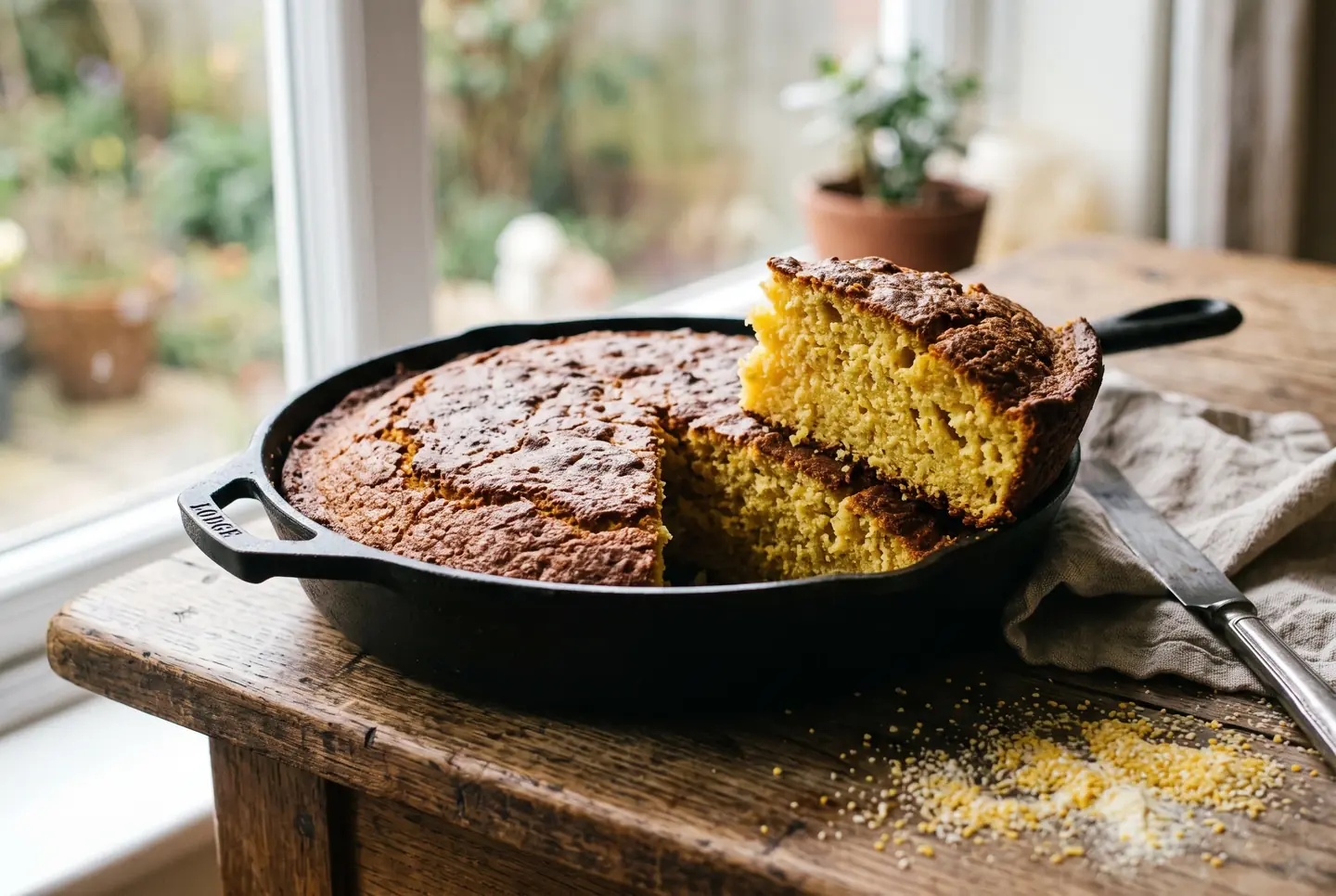
The trick that separates home corn bread from a flat pan of it is the cast-iron skillet preheated with fat inside. When the cold batter meets the screaming-hot iron, the edge fries on contact and forms that dark, crisp crust that is the bread's signature. Doneness is read at the centre, not on the clock: between 93 and 98 °C the crumb is moist but cooked. Push past that and it dries out.
Variations
The oldest fight in corn bread is over sugar. The Northern US version is sweet and fluffy like cake, with almost as much wheat flour as cornmeal. The traditional Southern one uses little or no sugar and little or no wheat, leans on white cornmeal and buttermilk, and comes out rougher and savoury.
There is skillet corn bread, baked with lard or bacon fat; hot water corn bread, of cornmeal and boiling water fried on a griddle; and the Texan version of Mexican influence, with fresh corn, jalapeño and cheese, a cousin of pan de elote. In Brazil and Portugal, broa de milho follows another path, with yeast and a dense crumb: a different bread, not a variation of this one.
Where it goes wrong
Mistake number one is overmixing the batter. Every extra turn develops the little gluten in the wheat and leaves the crumb elastic and heavy. Stir with a spoon, count to ten and stop.
The second is the wrong cornmeal: too fine and the bread has no texture, too coarse and it turns gritty. The third is baking until dry, since corn bread keeps cooking in the residual heat, so take it out the moment the centre reads 93 to 98 °C. The fourth is skipping the hot skillet, without which there is no crust.
Frequently asked
- Can I make it without buttermilk?
- Yes. Mix 290 g of plain milk with a tablespoon of lemon juice or vinegar and leave it five minutes until it curdles: the acid activates the baking soda. With no acid, use only baking powder and accept a denser loaf.
- Do I need a cast-iron skillet?
- It is not required, but it is what gives the crust. A regular pan works: grease it well and, if you can, preheat it in the oven before pouring in the batter. Without the hot metal the base comes out pale and soft.
- Why did my corn bread come out dry?
- Almost always too much oven or too much time. The crumb keeps cooking outside the oven, so pull it as soon as the centre reads 93 to 98 °C. Too much cornmeal against the liquid also dries it out.
- Sweet or savoury?
- It depends on where you sit at the table. The traditional South skips the sugar and serves the bread with beans and stews; the North likes it almost as a cake, with honey. Start with a little sugar and adjust to taste.