Flour
Khorasan flour: the giant ancient grain behind the KAMUT brand
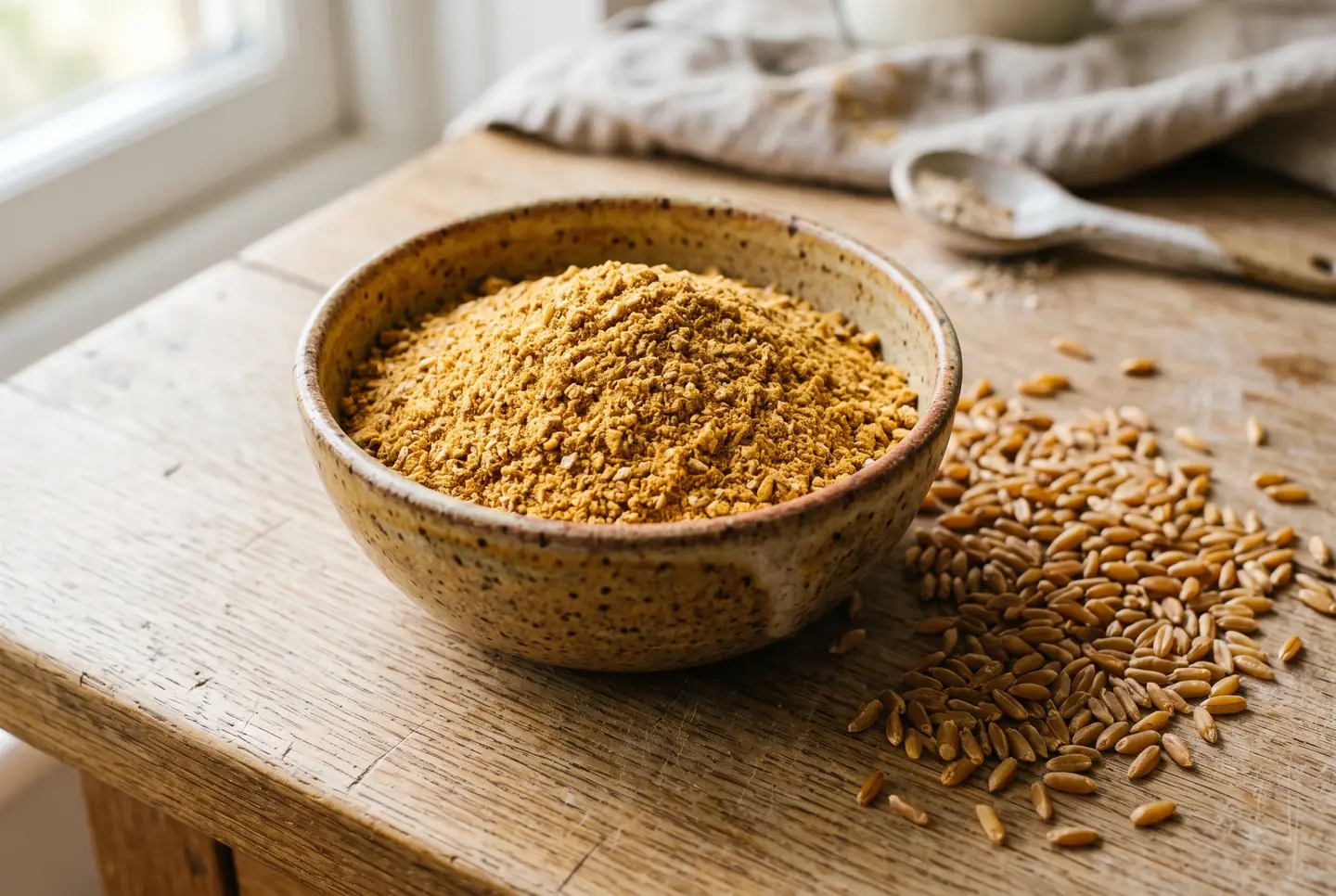
Khorasan is one of the great ancient wheats, a giant golden kernel with a buttery, sweet, nutty flavour. You will meet it more often under one brand name, KAMUT, and that name is doing more work than most people realise. Here is the grain, the trademark behind it, and what it does at the bench.
At a glance
- Strength (W)
- not measured
- Protein
- 13.5% to 16.4% *
- Water absorption
- not measured
- Stability
- not measured
- Ash
- not measured
- Origin
- Região histórica do Khorasan (Grande Irã e Ásia Central). O grão foi revivido nos anos 1980 por um agricultor de Montana (EUA), que registrou a marca KAMUT®
- Grain
- Triticum turgidum subsp. turanicum (Triticum turanicum), trigo tetraploide de grão muito grande e alongado, parente do trigo duro
Sources disagree. Khorasan reads like a strong flour on the label, with protein from 13.5% up to 16.4% depending on the source, but that number does not build a big airy loaf. The glutenin-to-gliadin balance is not the one an open crumb needs, so the high protein turns into flavour and extensibility rather than strength. Read it as an extensible, flavourful flour, not a strong bread flour: the loaf stays close and even where the number promised height.
What it is called in each country
| Country | Called |
|---|---|
| English | khorasan wheat; KAMUT® is a trademark for one cultivar (QK-77, USDA PVP), not a synonym |
| Português | trigo khorasan; Kamut® é marca registrada de uma cultivar (QK-77), não sinônimo do grão |
| Italiano | grano khorasan; Kamut® è marchio registrato di una sola cultivar (QK-77), non un sinonimo del grano |
| Français | blé de Khorasan; Kamut® est une marque déposée (cultivar QK-77), pas un synonyme du grain |
| Español | trigo khorasan; Kamut® es marca registrada de una cultivar (QK-77), no un sinónimo del grano |
What it is for
Khorasan is built for flavour, and it shows most in rustic bakes where that buttery, nutty sweetness has room to sit. It shines in hearth loaves and tin loaves, in blended breads, and in rustic cakes, pancakes and couscous. Being a durum relative, it also makes lovely fresh pasta, golden and with a firm, generous bite.
Where it truly earns its keep is in a blend. Cut 25% to 50% khorasan into common or whole wheat flour and you keep the structure the other wheat gives while buying all of khorasan's flavour and colour. A 50/50 with whole wheat is a classic pairing, deeply grainy without turning heavy. In practice the flour works well between 60% and 70% hydration, a touch drier than a bread flour.
How to substitute it
Swapping khorasan into a recipe you already know works well, as long as you adjust rather than trade one for one. Its absorption runs roughly 3% lower than bread flour, so hold a little water back and add it only if the dough asks. Keep the autolyse medium, and go easy on the folds: three stretch-and-folds at most, because you are working with an extensible dough, not a strong one that wants to be pushed.
The most natural way in is a blend, which is also where it tastes best. Its closest kitchen cousin is durum, so semolina (/farinhas/semolina/) is the obvious partner for pasta and rustic loaves. Among the other ancient wheats, einkorn (/farinhas/einkorn-flour/) and emmer (/farinhas/emmer-flour/) share the same soft, extensible character, so a common or whole wheat still carries the structural load.
When not to use it
Khorasan is the wrong flour when the whole point is maximum volume off very strong gluten. Skip it, or keep it to a small fraction, for very open high-crumb breads that live or die on a powerful gluten network, and for anyone who needs a pure strong flour to hit the biggest possible rise. The protein figure will tempt you, but the loaf will not follow.
One more thing it is not: gluten free. Many people who react to modern wheat report that they tolerate khorasan better, which is worth knowing but is not a health claim. Khorasan has gluten, full stop, and it is not safe for anyone with celiac disease. Tolerating a grain more comfortably is not the same as being able to eat it safely.
How to use it
Baking well with khorasan is mostly about respecting an extensible dough. Give it a medium autolyse, 30 to 45 minutes, to let the flour drink and relax, then mix gently. Keep the hydration in the 60% to 70% range, remembering it takes on a little less water than bread flour, so wetter is not automatically better.
Handle it with a light touch through the bulk: no more than three stretch-and-folds, because aggressive working will not build a strong network the flour cannot make anyway, and it can leave the dough slack and tired. If you want more height and a more open crumb, do not fight the flour, blend it with a stronger wheat and let that partner do the lifting while khorasan brings the flavour and colour.
How to choose one when buying
The first choice on the shelf is really a choice between a brand and a grain. KAMUT is the trademark, and paying for it buys the origin guarantees: certified organic, never hybridised or GMO, with a guaranteed minimum protein and selenium. Generic khorasan is usually cheaper and can be excellent, but it comes with none of those promises, so you are trusting the miller rather than the mark.
Either way, reach for stone-ground wholemeal if you want the full flavour, because that is where the buttery, nutty character really lives. Just remember that wholemeal keeps the germ, and the germ goes rancid, so buy small bags and use them fresh rather than stocking up.
The story
Khorasan is an ancient wheat, Triticum turgidum subspecies turanicum, a tetraploid grain and a close relative of durum. Its signature is size: a very long kernel, two to three times the size of modern wheat, which is why it earned the nickname King Tut's wheat.
The part most people never hear is that khorasan and KAMUT are not the same word for the same thing. Khorasan is the public-domain name of the grain, and anyone can grow it. KAMUT is a registered trademark for a single cultivar, QK-77, protected in the United States with USDA plant variety protection certificate 8900108. It was revived in the 1980s by Bob Quinn, a Montana farmer who built a brand around a promise.
That promise is the whole point of the trademark. KAMUT grain is always certified organic, never hybridised and never genetically modified, and it carries a guaranteed minimum protein content and a guaranteed level of selenium. So all KAMUT is khorasan, but not all khorasan is KAMUT: a generic bag carries none of those guarantees, only the grain itself.
Frequently asked
- Are khorasan and KAMUT the same thing?
- Not quite. Khorasan is the public-domain name of the grain, an ancient wheat anyone can grow. KAMUT is a registered trademark for one specific cultivar, QK-77, revived by a Montana farmer in the 1980s. So all KAMUT is khorasan, but not all khorasan is KAMUT: the brand adds guarantees the bare grain does not carry.
- Does khorasan wheat have gluten? Is it safe for celiacs?
- Khorasan has gluten, so it is not safe for anyone with celiac disease or a gluten intolerance. It is an ancient wheat, not a gluten-free grain. Some people who react to modern wheat say they tolerate khorasan more comfortably, but tolerating a grain better is not the same as it being safe. If you are avoiding gluten for medical reasons, khorasan is off the table.
- Can I swap common flour for khorasan in a recipe?
- Yes, with a couple of adjustments. Khorasan absorbs roughly 3% less water, so hold a little back and add it only if the dough needs it, keep the autolyse medium and go easy on the folds. It behaves best blended rather than used alone: start by replacing 25% to 50% of a common or whole wheat flour, which keeps the structure while you gain the flavour and colour.
- Why is KAMUT more expensive?
- You are paying for the guarantees behind the trademark, not just the grain. KAMUT is always certified organic, never hybridised or genetically modified, and comes with a guaranteed minimum protein and selenium content, all controlled through a single protected cultivar. Generic khorasan skips that certification, so it costs less but promises less. The premium buys assurance about how the wheat was grown and what is in it.