Bread
Rye bread: the story, the technique and a sourdough recipe that works at home
Rye bread looks heavy and difficult, but it is one of the most forgiving loaves there is, as long as you accept one truth: it does not get kneaded, it does not double in size, and it almost always wants sourdough. Understand why, and you can make it.
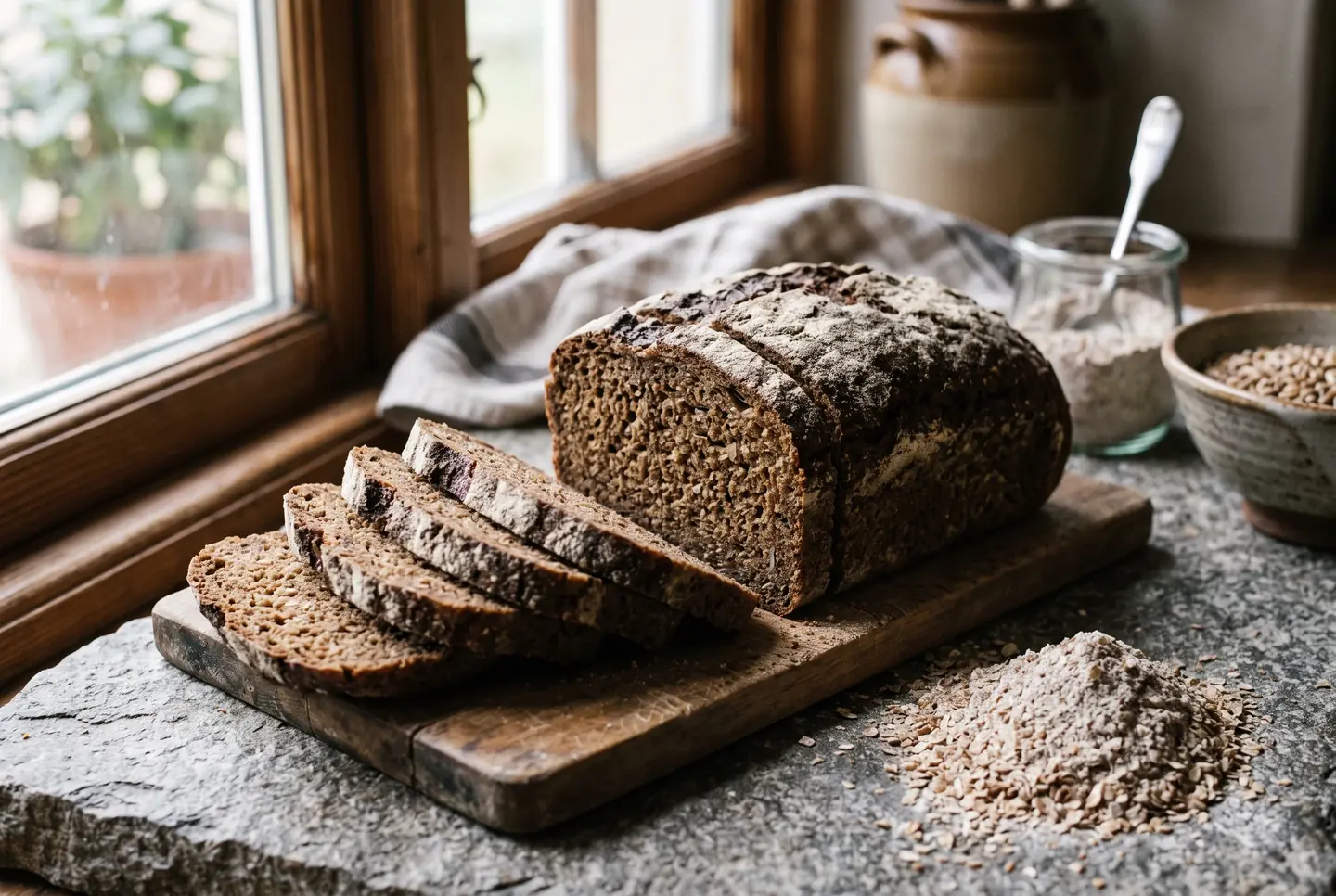
At a glance
- Origin
- Europa central, do norte e do leste
- Created
- not measured
- Hydration
- 70% to 85%
- Flour
- centeio (70%) com trigo para pão (30%)
- Leaven
- fermento natural de centeio
- Total time
- 18 h to 24 h
- Oven
- 250 °C
- Steam
- yes
- Internal temperature
- 96 °C to 98 °C
- Shape
- pão de fôrma
- Difficulty
The recipe
Ingredients
| Amount | baker's % | |
|---|---|---|
| Rye flour (for the levain) | 100 g | 20% |
| Water (for the levain) | 100 g | 20% |
| Active sourdough starter | 20 g | 4% |
| Rye flour | 250 g | 50% |
| Bread flour (W 260 to 300) | 150 g | 30% |
| Water | 275 g | 55% |
| Salt | 10 g | 2% |
Method
- The day before, make the rye levain: mix the 100 g rye flour, the 100 g water and the sourdough starter. Cover and leave 12 to 16 hours at 22 to 24 °C, until bubbly and clearly sour. That acidity is not about flavour: it is what stops rye's own enzyme from taking the starch apart in the oven.
- Next day, add the whole levain, the remaining 250 g rye, the 150 g bread flour, the 275 g water and the salt. Mix 4 to 5 minutes, just until homogeneous. Do not knead: rye builds no gluten network, and kneading constructs nothing.
- The dough will look like wet clay, sticky and with no elasticity. That is the correct state. Smooth the surface with a wet scraper.
- Bulk ferment 60 to 90 minutes at 26 °C, until the dough has visibly swelled and shows bubbles at the surface.
- Transfer to a greased 22 cm tin, press out air pockets and smooth the top with a wet hand.
- Final proof 60 to 90 minutes. The readiness signal in rye is not volume: it is the surface starting to open into fine cracks.
- Bake at 250 °C for 15 minutes with steam, then drop to 200 °C for another 45 to 50 minutes, until the centre reads 96 to 98 °C.
- Turn out and wait 24 hours before cutting. This is not fussiness: a rye crumb only finishes setting once it is fully cold, and cutting early gives you a gummy slice.
The right flour
This loaf needs rye flour, and rye is not dark wheat: it is a different cereal, without the gluten network that makes wheat bread rise. You will find light rye (just the starchy centre of the grain) and whole rye (with bran and germ). Light rye is easier and less sticky; whole rye brings more flavour, more colour and drinks more water. To start, a blend of 70% rye with 30% bread flour is the best of both worlds: the wheat lends a little structure that holds the slice together, while the rye runs the flavour. If you want to understand why rye behaves this way and how to choose between light and whole, see our rye flour reference at /farinhas/rye-flour/.
The story
Rye came into history through the back door. Nobody domesticated it on purpose: it arrived as a weed among fields of wheat and barley, and survived by mimicking the cultivated plant well enough to dodge the hoe. Loose grains show up across Europe from the Neolithic, but only in the Iron Age does rye stop being a weed and become a crop of its own.
What changed the game was the climate. Where the winter was too hard and the soil too poor for wheat, rye was the one thing that still gave a harvest, and that is how it took root across the north and east of Europe, from Germany to Russia. Dark bread is not a matter of taste, it is a limit of the land.
What defines it
What defines rye bread is not the colour, it is the chemistry. Rye barely forms gluten, so the dough never turns smooth or elastic: it looks like wet clay, and it is meant to. What holds the structure in place of gluten are the pentosans, fibres that absorb more than ten times their own weight in water and form a viscous gel.
That is why the crumb is close, moist and dense, and why the loaf keeps so long: a well made rye is still good on the fifth day, something no wheat bread manages. You will not see big holes or a crackling crust. The mark of success here is different: a firm slice, an earthy and lightly sour aroma, and a moisture that reads as damp without being raw.
How the dough behaves
The method for rye is almost the opposite of wheat. You do not knead it: kneading builds no network and only warms the dough, which then gets even stickier. You mix just until homogeneous, smooth the top with a wet scraper and let fermentation do the work.
The heart of it is acidity. Rye's own amylase enzyme attacks the starch exactly in the temperature band where it gelatinises inside the oven, and the result is that gummy crumb and a crust that lifts away. Sourdough fixes this: the low pH slows the enzyme and, as a bonus, makes the pentosans swell better, which holds the water and the structure. That is why real rye bread is almost always a sourdough bread, not a yeast bread.
The other rule is to read the surface, not the volume. The dough does not double. The moment to bake is when the top begins to crack into fine fissures.
Variations
The rye family is large. The German Mischbrot blends rye and wheat in varying proportions and is the everyday loaf of Germany. Vollkornbrot is made from whole grain and often carries soaked whole kernels in the dough. Pumpernickel, from the Westphalia region, is the extreme: coarse rye meal and a very low oven for 12 to 16 hours, which darkens the bread on its own, with no colouring, through the slow reaction between sugars and proteins.
On the Scandinavian side sit the dense, lightly sweet dark breads, often with molasses or malt. And there is always the gentler road: drop the rye to 20% or 30% and let the wheat carry the structure, for anyone starting out who wants a lighter loaf.
Where it goes wrong
The number one mistake is rushing the knife. A rye crumb only finishes setting once it is fully cold, and cutting before 24 hours gives you a gummy slice that reads as raw. Wait for real.
The second is skipping the acidity. With little rye, yeast can cope, but above 30% without a sour dough you run a real risk of a gummy crumb, because the enzyme keeps working in the oven. The third is pulling the loaf early: rye needs a well cooked crumb, near 96 to 98 °C at the centre. The fourth is trying to knead it smooth. Smooth rye dough does not exist: if yours is smooth, it is too dry.
Frequently asked
- Can I make rye bread without sourdough?
- You can, if the rye is a minority. Up to around 30% of the total flour, yeast copes. Above that, without acidity you risk a gummy crumb, because rye's enzyme keeps taking the starch apart inside the oven.
- Why did my rye bread come out gummy inside?
- Almost always one of three things: not enough acidity, the oven stopped too early, or the knife before 24 hours. Check the internal temperature, which needs to reach 96 to 98 °C, and only cut the next day.
- Is rye bread healthier than white bread?
- It tends to have more fibre and keep you full longer, and a dense whole grain rye usually raises blood sugar more slowly. But it is still bread.
- Why does the dough not rise like wheat?
- Because rye forms no gluten network to trap gas in big bubbles. It rises little and the crumb is close on purpose. Do not wait for it to double: wait for the surface to start cracking, which is the sign it is ready.