Bread
Banana bread: the no-knead quick bread that turns black bananas into a moist, tender loaf
Banana bread is not really bread at all: it is a quick bread, leavened with baking soda instead of yeast, with no kneading and no rise to wait out. The reward is a moist, tender loaf you can have in the oven ten minutes after the bananas go black. Get two things right, weak flour and a barely mixed batter, and the rest looks after itself.
At a glance
- Origin
- Estados Unidos
- Created
- 1933, difundido pela Pillsbury (livro Balanced Recipes)
- Hydration
- not measured
- Flour
- comum / fraca (all-purpose)
- Leaven
- químico (bicarbonato de sódio)
- Total time
- 1 h to 2 h
- Oven
- 175 °C
- Steam
- no
- Internal temperature
- 93 °C to 96 °C
- Shape
- bolo de fôrma (23 cm)
- Difficulty
The recipe
Ingredients
| Amount | baker's % | |
|---|---|---|
| All-purpose flour | 250 g | 100% |
| Very ripe bananas, mashed (about 3) | 300 g | 120% |
| Brown sugar | 150 g | 60% |
| Melted butter (or oil) | 115 g | 46% |
| Eggs | 100 g | 40% |
| Baking soda | 5 g | 2% |
| Salt | 3 g | 1.2% |
| Vanilla extract | 5 g | 2% |
Method
- Heat the oven to 175 C and grease and line a 23 cm loaf tin, so the loaf lifts out cleanly later.
- Peel 3 very ripe bananas (about 300 g) into a large bowl and mash them well with a fork until nearly smooth.
- Add 115 g melted butter, 150 g brown sugar, 2 eggs and 5 g vanilla, and whisk everything into the banana until smooth.
- In a separate bowl, stir together 250 g all-purpose flour, 5 g (1 tsp) baking soda and 3 g salt.
- Tip the dry mix into the wet and fold gently, just until no dry flour remains. The batter stays thick and lumpy, so do not beat it smooth.
- If you like, fold in 60 g toasted walnuts or pecans at this point.
- Pour the batter into the tin and bake at 175 C for 50 to 60 minutes, until the centre reads 93 to 96 C or a skewer comes out with a few moist crumbs.
- Cool for 10 minutes in the tin, then turn out onto a rack and cool completely; the flavour deepens after a few hours.
The right flour
This is the one loaf where you do not want strong flour. Banana bread is a quick bread, closer to cake than to a kneaded loaf, and its whole appeal is a soft, moist, tender crumb. Reach for plain, weak all-purpose flour, all-purpose flour (/farinhas/all-purpose-flour/). Bread flour, or any strong flour, is the classic wrong turn: the extra gluten builds an elastic, rubbery structure that bakes chewy and tends to sink in the middle as it cools. If anything you want to go softer, not stronger. Cake flour, cake flour (/farinhas/cake-flour/), is even lower in protein and gives a more delicate, almost melting crumb, which is why some bakers cut a little of it into the all-purpose. The rule is simple: here gluten is the enemy of tenderness, so keep the flour weak.
The story
Banana bread is an American invention, born in the kitchens of the 1930s. The Great Depression made throwing food away unthinkable, and a bunch of bananas gone soft and spotty was too good to bin. Mashing them into a sweet, cakey loaf turned a near miss into dessert, and the habit stuck.
The timing was no accident. Baking soda and baking powder had just become cheap and widely available, and the companies that sold them printed quick-bread recipes to move product. The first version to reach a wide audience appeared in Pillsbury's Balanced Recipes in 1933. Two decades later Chiquita took up the cause and helped push banana bread into mainstream American home baking through the 1950s.
It never really left, and in 2020 it came roaring back: stuck at home with ripening fruit on the counter, half the world seemed to bake a loaf at once.
What defines it
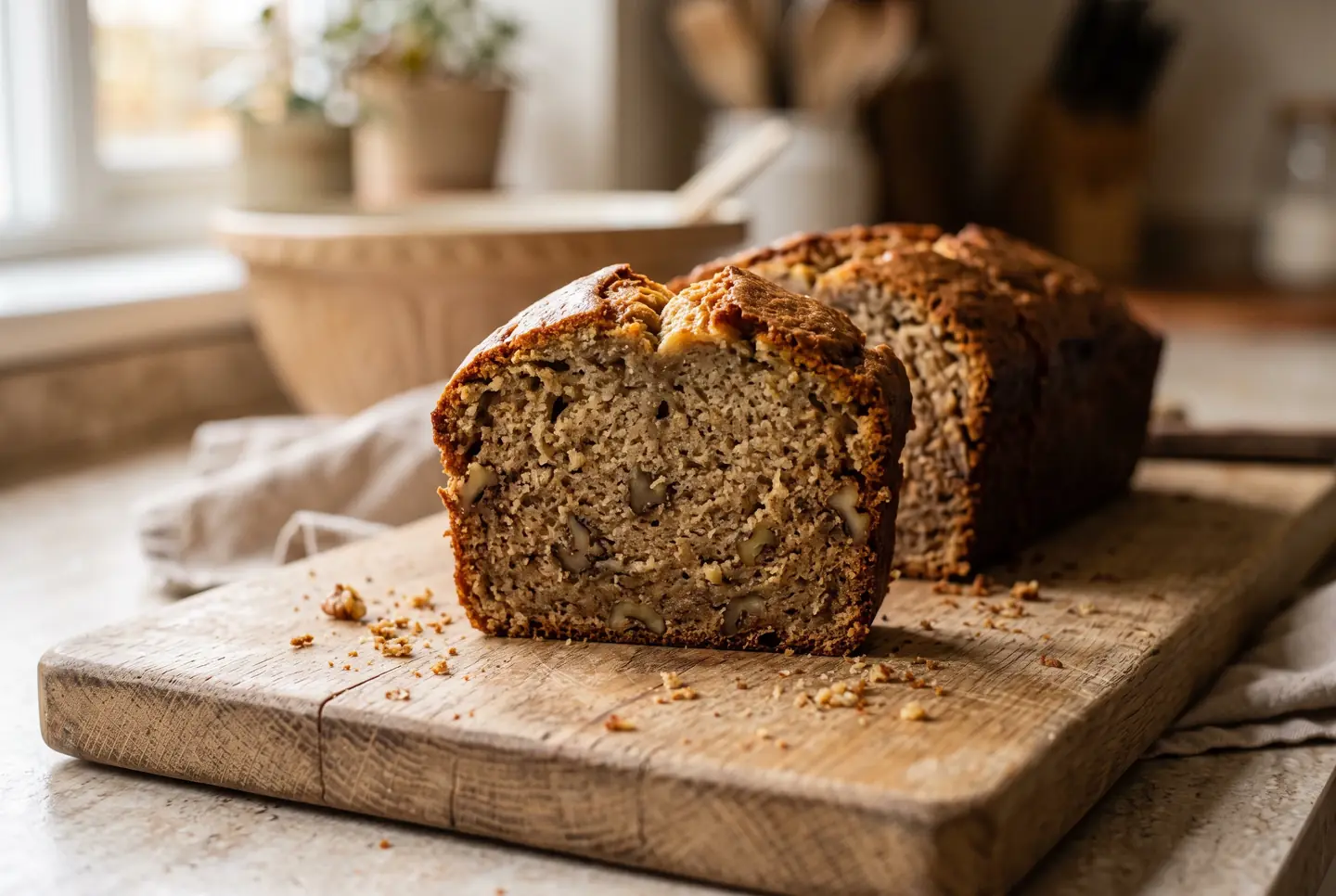
A good banana bread is unmistakably moist without being wet, with a crumb that is close and soft rather than airy. The flavour should be properly banana, deep and a little caramelised, not a faint hint you have to hunt for, which is why very ripe fruit matters so much. The top domes up and splits along the middle in a long crack: that is not a fault, it is what a quick bread does when the outside sets before the rise finishes, and it marks a loaf that climbed well. Slice into it and the centre should be cooked through, tender and even, never a rubbery chew or a gummy, raw seam down the middle.
How the dough behaves
There is no kneading here and no proving to wait out. Banana bread is built with the muffin method, which is really just two bowls and a gentle hand. In one bowl you whisk everything wet: the mashed banana, the eggs, the melted butter, the sugar and the vanilla. In the other you stir the dry ingredients, the flour, the baking soda and the salt, so the leavening is spread evenly before it meets any liquid. Then you fold the two together, and this is the whole game: stop the moment no dry flour is left. The batter should stay thick, rough and lumpy, and that is correct. Beating it smooth feels tidy but it develops gluten, and gluten is what turns the loaf tough and sunken. Use very ripe bananas, skins heavily spotted or gone black; they carry more flavour and sweetness and mash to a purée with almost no effort.
Variations
The plain loaf is a base, not a finish line. A handful of toasted walnuts or pecans is the classic addition, folded in at the end for crunch, and chocolate chips turn it into something children fight over. You can swap up to half the flour for whole wheat for a nuttier, sturdier loaf, or use a neutral oil in place of the butter for extra moisture. A spoon of yogurt or sour cream keeps it damp, a little cinnamon warms it up, and a few banana slices laid on top bake into a handsome, glossy lid.
Where it goes wrong
Most disappointing loaves come from one of five places. First, bananas that were not ripe enough: pale yellow fruit has little flavour and little sweetness, so wait until the skins are heavily spotted or black. Second, overmixing, the single most common mistake, which builds gluten and gives you tunnels, a tough chew and a top that sinks as it cools. Third, the oven: open the door too early and the rise collapses, and pulling the loaf while the centre is still raw leaves a gummy, wet seam. Check with a thermometer, 93 to 96 C in the middle, or a skewer that comes out with a few moist crumbs rather than wet batter. Fourth, too much banana, which weighs the crumb down into something dense and damp. Fifth, a tin that is too small, so the batter climbs over the rim as it bakes.
Frequently asked
- Why is my banana bread rubbery or sunken in the middle?
- Almost always too much mixing. Stirring the batter smooth develops gluten, which makes the crumb elastic and pulls the top down as the loaf cools. Fold only until the flour disappears and leave the batter lumpy. Strong bread flour has the same effect, so keep the flour weak.
- Which bananas should I use?
- The uglier the better. You want very ripe fruit, skins heavily spotted or gone black, because that is when the starch has turned to sugar and the flavour is deepest. Firm yellow bananas make a pale, bland loaf, and overripe ones also mash to a smooth purée with almost no effort.
- Can I use whole wheat or gluten-free flour?
- Whole wheat, yes: swap up to half the all-purpose for a nuttier, denser loaf, and any more starts to taste heavy. Gluten-free blends work too, since this bread never relied on gluten for structure; use a cup-for-cup blend and expect a slightly softer crumb.
- Why is it called bread if it is like cake?
- The name comes from how it is baked, not how it tastes. It rises with baking soda and goes into a loaf tin like a bread, so it took the name. In texture it is really a moist cake, happy as breakfast, snack or dessert.