Flour
Oat flour: what it is, what it is for, and how to use it
It is high in protein and still will not raise a loaf on its own. The reason is not how much protein it has, it is the kind: oats do not have the network wheat has, and that changes everything in the bowl.
At a glance
- Strength (W)
- not measured
- Protein
- 13% to 17%
- Water absorption
- not measured
- Stability
- not measured
- Ash
- 1.7% to 2%
- Origin
- climas frios e úmidos do hemisfério norte (Canadá, norte da Europa, Rússia)
- Grain
- aveia (Avena sativa); proteína de reserva avenina, sem glúten formador de rede
What it is called in each country
| Country | Called |
|---|---|
| English | wholegrain oat flour; certified gluten-free (purity protocol) for coeliacs |
| Português | farinha de aveia (integral, moagem fina); para celíacos, aveia certificada sem glúten |
| Italiano | farina di avena (integrale); per celiaci, avena certificata senza glutine |
| Français | farine d'avoine (complète); pour intolérants, avoine certifiée sans gluten |
| Español | harina de avena (integral); para celíacos, avena certificada sin gluten |
What it is for
Oat flour shines where softness and moisture count for more than volume. Pancakes, muffins and waffles gain a moist crumb and a buttery, biscuit-like flavour white flour does not have. Cookies come out soft in the middle with edges that snap.
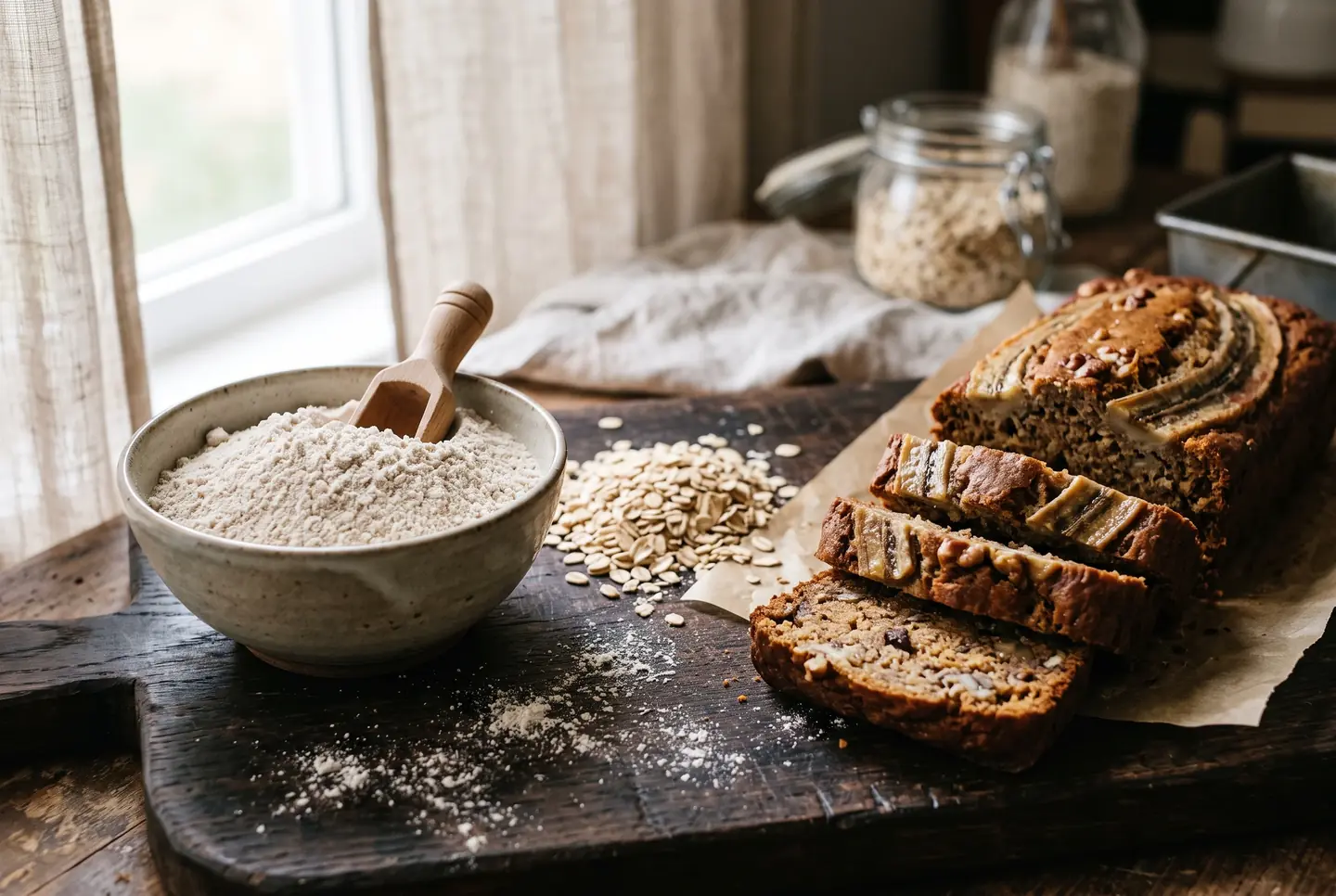
In a sandwich tin loaf it goes in blended with wheat, typically 20% to 30% of the flour weight, returning a softer crumb and a toasted aroma. Muffins made half with oats stay soft for days, where an all-wheat crumb would go stale by the second morning. Banana bread is the perfect case: the batter is already moist and dense, so oats fit right in.
And the obvious one that is barely a flour: porridge. Cooked slowly with milk or water, the beta-glucan thickens into a cream no other flour imitates.
How to substitute it
Making oat flour at home is the cheapest trick in the pantry: blitz rolled oats in a food processor or blender until they turn to a fine powder, and that is it. Always weigh it, because volume lies, and a cup of oats yields less than a cup of flour.
How you swap depends on the recipe. In cakes, muffins and pancakes you can replace much of the wheat flour, remembering that oats drink more water: add a spoon or two of liquid and let the batter rest ten minutes, because it absorbs slowly.
The sensitive point is structure. Without gluten, oats crumble. In a recipe that relied on the wheat network you need a binder: xanthan gum (about half a teaspoon per cup of oats) or an extra egg. In yeast bread, do not swap it all: keep around 70% wheat flour and cap the oats at 30%, or the loaf turns into a brick.
When not to use it
Bread that has to rise tall, made from oats alone. With no gluten network there is nothing to trap the gas: the dough barely grows, splits and sinks, and the crumb comes out dense and too damp.
The same goes for a tall sandwich loaf built on oats alone: it wants the scaffolding only gluten provides, and without it the top caves as it cools.
Laminated doughs are out too, completely. Croissants and puff pastry rely on a strong, extensible gluten to hold the butter layers, and oats do not stretch, they break. Anything whose whole point is a chewy bite, from a bagel to a Neapolitan pizza, loses its reason for being when made of oats only.
How to use it
Two things change when oats enter the bowl: the water and the time. Oat flour absorbs noticeably more liquid than ordinary wheat flour, because the beta-glucan and fibre hold a lot of water, and it does so slowly. Judge the batter in the first minute and you will decide it is too loose, correct it with more flour, and end up with a dry cake. Mix, wait ten minutes, then judge.
W strength and stability are absent from the table for an honest reason: those tests measure how a gluten network behaves on the farinograph, and oats have no network to measure. Leaving them blank is more correct than inventing a number.
One note on flavour: raw oats have a faintly astringent edge. Toasting the flour in a dry pan for a few minutes, until it smells like biscuits, takes that off and lifts everything. And do not overwork the batter chasing an elasticity that will never come, since there is no network to develop: mixing just enough to combine is the whole job.
How to choose one when buying
On the label, look at three things. First, wholegrain or refined: wholegrain keeps the bran, so it has more fibre and more beta-glucan, and it is the one worth buying. Second, the grind, look for fine and powdery, not coarse and bran-like. Third, and most important for anyone with coeliac disease: certified gluten-free.
Oats have no gluten by nature, but they are almost always grown, hauled and milled alongside wheat, barley and rye, so cross-contamination is the rule, not the exception. Only the certification seal (a purity protocol, with dedicated fields and equipment and testing below 20 ppm) makes it safe. Without coeliac disease, ordinary oat flour is fine. Brands like Bob's Red Mill and Anthony's sell both versions, so read whether the bag says certified gluten-free.
The story
Oats (Avena sativa) are a cold, wet climate grain, old food of northern Europe long before they became a symbol of a healthy breakfast. The difference that matters in the kitchen is not the reputation, it is the protein.
Wheat has two proteins, gliadin and glutenin, which make up most of its protein and, with water and mechanical work, bond into an elastic network: gluten. That network traps fermentation gas and gives bread its open crumb and chewy bite.
Oats have no such network. Their storage protein is avenin, a prolamin that accounts for only 10% to 15% of the total and does not organise into a mesh. So oat flour is high in protein (around 13% to 17%, sometimes more than white flour) and still cannot hold up a loaf by itself. High protein is not the same as structural protein.
Its real star is something else: beta-glucan, a soluble fibre the grain carries at roughly 4%. That is what binds water, gives porridge its creaminess, and underpins the health claim that both EFSA and the FDA recognised: about 3 g a day of oat beta-glucan helps lower blood cholesterol.
Frequently asked
- Can I swap wheat flour for oat flour one for one?
- In cakes, muffins and pancakes you can, with tweaks: add a little liquid, because oats drink more, and let the batter rest. In yeast bread you cannot, because without gluten it will not rise. There, keep it to about 30% oats and 70% wheat.
- Is oat flour gluten-free?
- Oats themselves do not have wheat's gluten, only a similar protein called avenin, which most people with coeliac disease tolerate. The real problem is cross-contamination in the field and the mill. For coeliacs, only the certified gluten-free version is safe.
- How do I make oat flour at home?
- Blend rolled oats in a blender or food processor until they turn to a fine powder, a minute or two. Sift for a lighter result. Weigh it, because a cup of oats does not become a cup of flour.
- Why did my oat cake come out dry or crumbly?
- Two common causes. Dry: you corrected the batter too early, before the oats absorbed the water, so wait ten minutes. Crumbly: it lacked a binder, and without gluten oats need an extra egg or a little xanthan gum.